If you’re studying George Orwell’s Animal Farm, chances are you’ve searched Lit Charts Animal Farm looking for a faster way into the book’s plot and meaning. Lit Charts breaks the novel into short, color-coded sections instead of dense analysis blocks, which makes it easier to track themes like power and corruption as you read. This guide walks through what the Lit Charts Animal Farm page actually covers — plot, characters, symbols, quotes — and whether the free tier is enough or A+ is worth paying for.
What Is Animal Farm About?
Animal Farm is George Orwell’s 1945 political fable about farm animals who overthrow their human farmer, hoping to build a fairer society. The story quickly becomes an allegory for the Russian Revolution, with the pigs standing in for Soviet leadership.
The Lit Charts Animal Farm guide frames the book around one core question: what happens when a revolution’s ideals get rewritten by the people holding power? That framing shapes how every chapter summary and theme page on the site is organized.
Animal Farm Plot Summary
The novel opens with Old Major, an aging boar, describing a dream of animals living free from human control. His speech introduces Animalism, the philosophy the animals adopt after driving out Farmer Jones in the rebellion that follows.
Leadership soon splits between two pigs, Napoleon and Snowball, whose rivalry ends when Napoleon uses trained dogs to force Snowball off the farm. From there, Napoleon rules alone, and the Seven Commandments the animals wrote at the start begin quietly changing.
By the final chapters, the pigs walk upright, trade with humans, and are indistinguishable from the farmers they once overthrew. Lit Charts’ chapter-by-chapter format is useful here because it isolates each small rule change, making the book’s slow corruption of power easier to trace than in a standard summary.
Two turning points sit between these bookends: the Battle of the Cowshed, where the animals repel a human counterattack, and the long, disputed project to build a windmill, which Napoleon later blames on Snowball’s sabotage whenever it collapses or falls behind schedule. Lit Charts treats both events as evidence of how Napoleon manufactures external threats to excuse his own failures.
Key Themes in Animal Farm
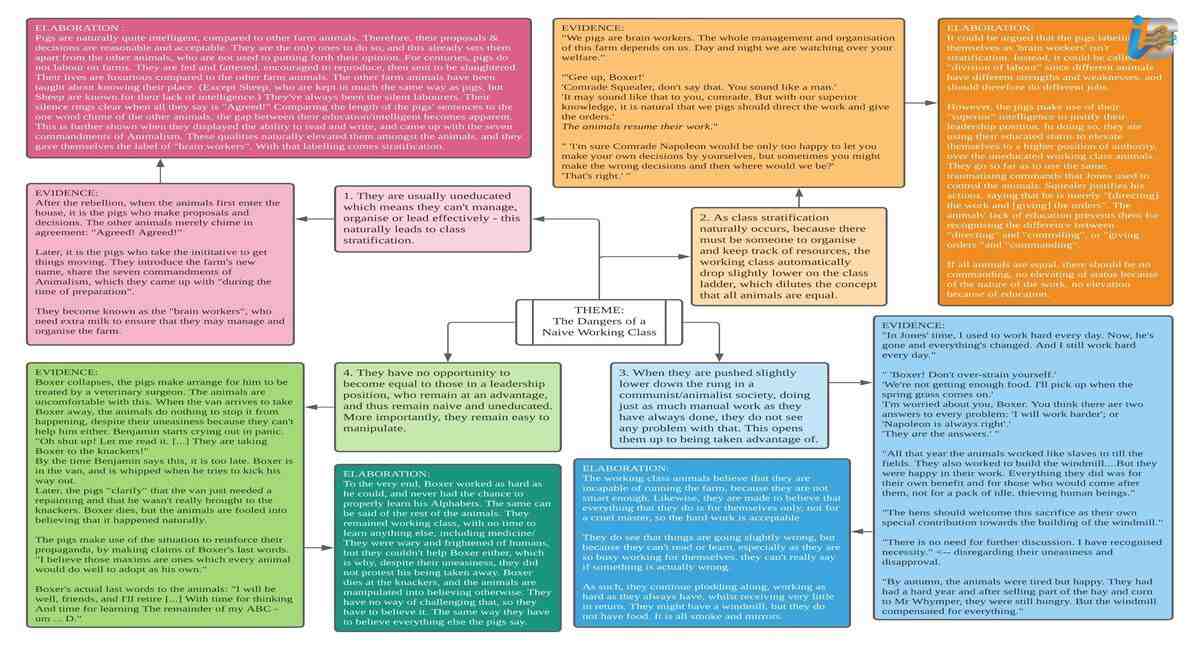
The Lit Charts theme tracker highlights power and corruption as the central thread, showing how each new pig privilege — better food, a house, alcohol — mirrors a real shift in Soviet history. This side-by-side structure is arguably the guide’s most useful feature for essay writing.
A second major theme is propaganda and language, tracked mainly through Squealer, the pig who justifies every broken promise to the other animals. Orwell used Squealer to show how language itself can be twisted into a tool of control, a point Lit Charts ties directly to specific quotes.
Class and education form a third theme, visible in how the pigs monopolize learning while animals like Boxer remain illiterate and easy to exploit. Lit Charts links this theme to the ending, where the animals can no longer tell the pigs apart from the humans they replaced.
Animal Farm Character Guide
Napoleon, modeled on Joseph Stalin, consolidates power through fear rather than persuasion, using violence and propaganda instead of the debate Snowball preferred. Lit Charts’ character page tracks his shift from co-leader to sole dictator across the novel.
Snowball, representing Leon Trotsky, is idealistic and reform-minded but gets exiled before his plans can succeed, becoming a convenient scapegoat for later farm failures. Boxer, the loyal cart-horse, represents the working class exploited by leadership that never intended to reward his labor.
Old Major dies before the rebellion even begins, but his early vision of Animalism is the standard every later betrayal gets measured against. Squealer, Napoleon’s mouthpiece, rounds out the main cast by turning every broken promise into something that sounds, on the surface, like progress.
Symbols and Literary Devices in Animal Farm
The Seven Commandments, painted on the barn wall, symbolize the revolution’s founding ideals — and their gradual editing throughout the book is one of the clearest tracked details in the Lit Charts guide. Each rewritten commandment marks a specific betrayal.
Satire and allegory are the book’s main literary devices, letting Orwell criticize Soviet history without naming it directly. Lit Charts’ symbol page connects the farm’s windmill, the dogs, and the pigs’ clothing to specific real-world parallels for readers writing analytical essays.
Napoleon’s trained guard dogs symbolize the secret police used to enforce loyalty through fear rather than debate, while the windmill itself doubles as a symbol of forced labor promised as future prosperity that never quite arrives. Reading these two symbols together makes Napoleon’s control tactics easier to explain in an essay.
Important Animal Farm Quotes Explained
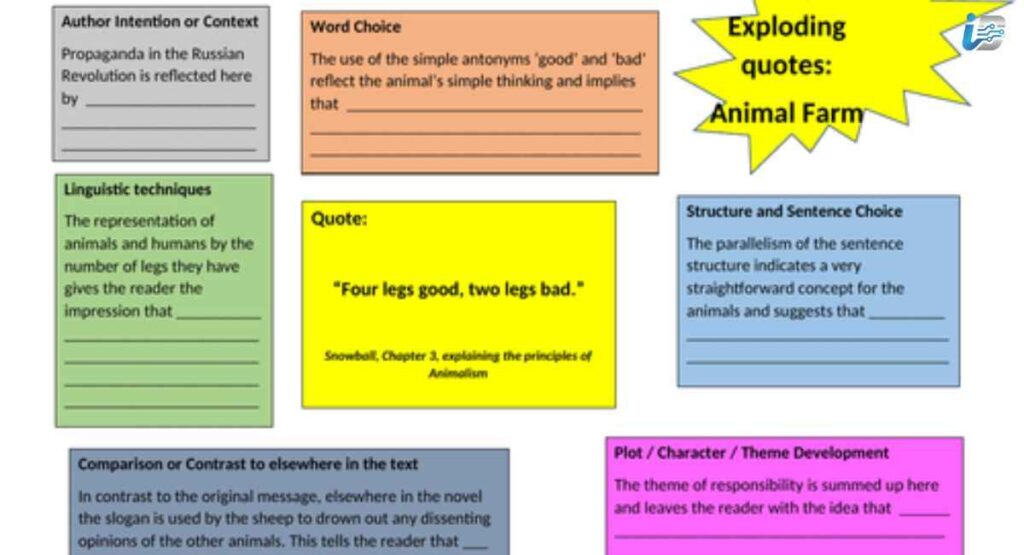
One widely cited line changes the original commandment that “all animals are equal” by adding that some are “more equal than others,” summarizing the novel’s entire arc in a single edited sentence. Lit Charts’ quote pages explain exactly where and why this change appears.
Squealer’s repeated justifications, and Boxer’s personal motto about working harder, are two more quotes Lit Charts breaks down with citation details for essays. Free users can read these quotes in context; A+ adds one-click formatted citations for each one.
Lit Charts Animal Farm Guide: Free vs A+
The free Lit Charts Animal Farm page covers the full plot summary, theme tracking, character list, and symbol breakdown at no cost, which is enough for most students preparing for a class discussion or quick review.
Lit Charts A+, priced at $10.95 per month (with an annual plan that cuts the cost by close to 50%), adds a downloadable PDF of the full guide, formatted quote citations, and a Teacher Edition with ready-made discussion questions for classroom use.
| Feature | Free | Lit Charts A+ |
| Plot summary & chapter breakdown | ✅ | ✅ |
| Theme tracking | ✅ | ✅ |
| Character & symbol guides | ✅ | ✅ |
| Downloadable PDF | ❌ | ✅ |
| Formatted quote citations | ❌ | ✅ |
| Teacher Edition & discussion questions | ❌ | ✅ |
Lit Charts vs Spark Notes vs Cliffs Notes for Animal Farm
Spark Notes’ Animal Farm page uses longer traditional summary-then-analysis paragraphs, while Lit Charts’ color-coded, bite-sized format suits readers who want to jump straight to a specific theme or chapter. Both cover the book thoroughly, so the choice mostly comes down to reading style.
Cliffs Notes remains the free, ad-supported option of the three, with solid chapter summaries but fewer of the theme-tracking tools that make lit charts useful for essay planning. Cross-checking two of these sources is generally the safer habit before submitting a graded assignment.
For a short political fable like Animal Farm, the difference matters more than it would for a longer novel — a book this compact rewards the kind of detail-level tracking lit charts does, since a single altered commandment or shifted alliance carries real weight in a ten-chapter story.
FAQs
Is Animal Farm OK for a 12-year-old?
Yes, generally — it’s often assigned around ages 11–13. The prose is simple, though some violence (animal deaths, executions) and dark political themes warrant a quick parent/teacher conversation.
What is Animal Farm and why is it banned?
It’s George Orwell’s 1945 allegorical novella satirizing the Russian Revolution and Stalinism. It’s been banned in various countries (historically the USSR, and at times in places like the UAE and North Korea) for criticizing communism, totalitarianism, and specific real-world leaders.
Is Animal Farm a difficult read?
No — it’s short (around 30,000 words) and written in plain, fable-like language, making it one of the more accessible classics for middle and high school readers.
What are the 7 rules in Animal Farm?
The Seven Commandments of Animalism include rules like “No animal shall wear clothes,” “No animal shall sleep in a bed,” “No animal shall kill any other animal,” and “All animals are equal” — later corrupted by the pigs.
Who is the real villain in Animal Farm?
Napoleon, who represents Stalin, is the central villain — he seizes power through fear, propaganda, and betrayal rather than genuine leadership.
What is the main message of Animal Farm?
Orwell’s central message is that revolutions can be corrupted by the same abuses of power they set out to end, shown through the pigs’ gradual transformation into the farmers they overthrew.
Who does Napoleon represent in Animal Farm?
Napoleon represents Joseph Stalin, reflecting his consolidation of Soviet power through propaganda, fear, and the elimination of political rivals like Trotsky.
Is the Lit Charts Animal Farm guide free?
Yes. The free tier includes the full plot summary, theme tracking, character guide, and symbol analysis; only PDF downloads and formatted citations require an A+ subscription.
Why does Animal Farm end with the pigs walking on two legs?
It’s Orwell’s final image of the pigs becoming indistinguishable from the humans they replaced, showing the revolution has fully failed its original ideals.
How long is Animal Farm?
The novel is short, around 30,000 words across ten chapters, which is one reason students often look for a fast, well-organized guide like lit charts.
Is Animal Farm based on a true story?
Not literally, but it closely mirrors real events: the rebellion parallels the 1917 Russian Revolution, and Napoleon’s rise mirrors Stalin’s actual purges of rival Soviet leaders.
Final Verdict
For students studying Animal Farm, the lit charts guide’s biggest strength is how clearly it tracks the book’s central theme — power corrupting revolutionary ideals — chapter by chapter. The side-by-side theme and chapter breakdown makes it easier to find a specific detail for an essay than flipping back through the novel itself. The free version covers everything most readers need; A+ is worth it mainly for teachers or students who want offline PDFs and ready-made citations. As with any study guide, it works best alongside the novel itself, not instead of it — reading the original text is still the only way to catch Orwell’s tone and timing, which no summary fully replicates.

Welcome to Infoz Style I am Karl Braun ,an Ai – powered SEO , and Content Writer With 4 Years of experience. I help Websites Rank higher , grow traffic , and look amazing . My goal is to make SEO and Web design simple and effective for everyone.
Let`s achieve more together !