If you need a fast, complete Animal Farm summary, theme in animal farm and animal farm analysis, you’re in the right place. George Orwell’s slim political allegory packs revolution, betrayal, and propaganda into barely 30,000 words — which is exactly why it still trips up readers looking for a quick refresher. This guide walks through the plot, the characters, the Seven Commandments, the Russian Revolution parallels, and the book’s biggest themes, so you leave with a real understanding instead of a skimmed character list.
What Is Animal Farm About?
At its core, animal farm main themes is a satirical fable about farm animals who overthrow their human owner, only to end up worse off under a new set of rulers — the pigs. Orwell published the book in 1945 as a “fairy story” with sharp teeth, using talking animals to dramatize how the Russian Revolution curdled into Stalinist dictatorship. The surface plot is simple enough for a child to follow; the politics underneath are not.
The novella is short on purpose. Orwell wanted the story to read like a bedtime tale while smuggling in a serious warning: idealistic uprisings can be hijacked by the very leaders who promised equality in the first place. That gap between hope and betrayal is what drives nearly every chapter, and it’s why teachers still assign the book eight decades later.
Animal Farm Summary: Chapter-by-Chapter Breakdown
Chapter 1: Old Major’s Dream
Old Major, an elderly, prize-winning boar, calls the animals of Manor Farm together one night while their drunken owner, Mr. Jones, sleeps. He describes a dream of a world without human exploitation and teaches the animals the anthem “Beasts of England.” His speech plants the seed of rebellion, though he dies just three nights later.
Chapters 2–3: The Rebellion and the Golden Age
Two younger pigs, Snowball and Napoleon, refine Old Major’s ideas into a philosophy called Animalism. When Jones forgets to feed the animals, a spontaneous revolt breaks out, and they drive him off the land for good. The farm is renamed Animal Farm, the Seven Commandments go up on the barn wall, and the first harvest under self-governance is a genuine success.
Chapters 4–6: The Battle of the Cowshed and the Windmill Dispute
The animals repel a human counter-attack in what becomes known as the Battle of the Cowshed — morale has never been higher. Snowball then proposes a windmill to generate electricity and cut the animals’ workload, but Napoleon publicly opposes it, setting up the story’s central power struggle. During the vote, Napoleon unleashes a pack of dogs he secretly raised from puppies and chases Snowball off the farm permanently. He then claims the windmill was his idea all along and drives the animals into brutal overwork, blaming every hardship on the now-exiled Snowball.
Chapters 7–8: Purges and Rewritten History
Napoleon’s chief propagandist, Squealer, begins quietly rewriting the Seven Commandments to justify the pigs’ growing privileges. Animals who “confess” to invented crimes are executed in front of the others, and fear replaces the solidarity that once defined the farm. The hens, who briefly try to resist Napoleon’s order to surrender their eggs, are brutally put down — the clearest sign yet that the revolution has curdled into the very tyranny it replaced.
Chapters 9–10: Boxer’s Betrayal and the Final Transformation
Boxer, the tireless cart-horse whose personal motto is “I will work harder,” collapses from exhaustion and is quietly sold to a glue factory while Squealer lies about his fate to the other animals. By the final chapter, the pigs walk upright, wear clothes, and dine with human farmers — and the animals watching through the window can no longer tell one from the other.
Meet the Characters of Animal Farm
| Character | Role on the Farm | Real-World Parallel |
| Old Major | Elderly boar who inspires the revolution | Karl Marx / Vladimir Lenin |
| Napoleon | Ruthless pig who seizes total power | Joseph Stalin |
| Snowball | Idealistic, intelligent rival pig | Leon Trotsky |
| Squealer | Chief propagandist | Soviet state media |
| Boxer | Devoted, hardworking cart-horse | The exploited working class |
| Mr. Jones | Neglectful original farm owner | Tsar Nicholas II |
| Moses the Raven | Preaches of “Sugarcandy Mountain” | The Russian Orthodox Church |
| Benjamin | Cynical, world-weary donkey | The disillusioned intellectual |
Each animal works as a piece of a larger political puzzle, and matching these historical parallels is the fastest way to understand what Orwell is actually satirizing rather than just what’s happening on the surface.
Beyond the main cast, minor characters carry weight too. Mollie, the vain horse obsessed with ribbons and sugar, represents the segment of the population indifferent to politics as long as comfort is preserved. The sheep, who mindlessly repeat slogans like “four legs good, two legs bad,” embody how easily crowds can be manipulated into drowning out dissent.
The Seven Commandments of Animalism
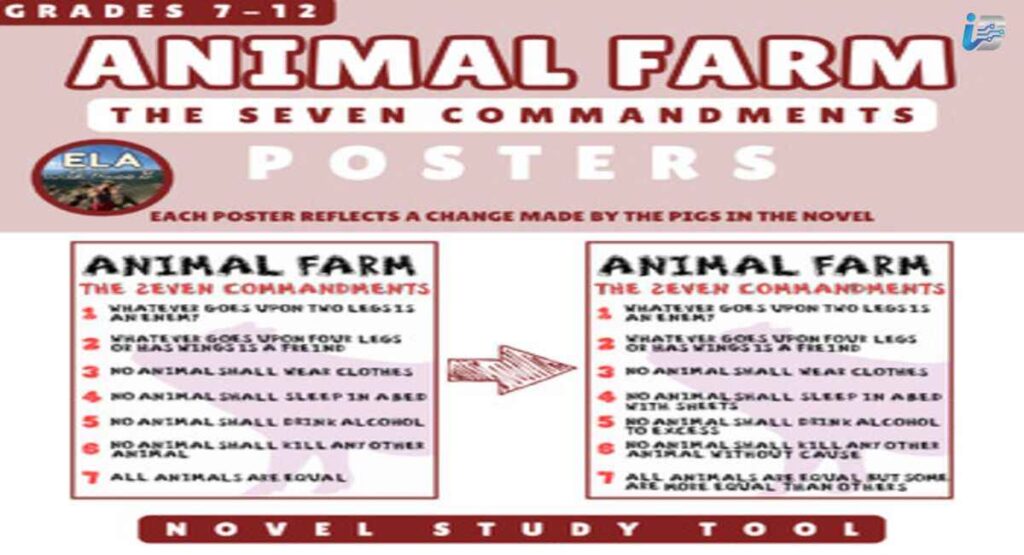
The founding rules start out simple: no animal shall wear clothes, sleep in a bed, drink alcohol, or kill another animal, and crucially, all animals are equal. These commandments represent the purest version of the animals’ revolutionary ideals, painted where every resident of the farm can see them and, in theory, hold the leadership accountable.
Over the course of the story, the pigs quietly edit each rule to fit their own behavior — “no sheets” gets appended to the bed rule, and “to excess” gets added to the alcohol rule. By the end, only one commandment survives, altered beyond recognition: some animals are “more equal than others.” Tracking these edits chapter by chapter is one of the clearest ways to watch corruption unfold in real time.
Animal Farm as a Political Allegory: Who Represents Who
Orwell constructed the novella as a near point-for-point allegory of the Russian Revolution and its aftermath. The uprising against Mr. Jones mirrors the fall of the Tsar, while the uneasy early cooperation between Snowball and Napoleon echoes the fragile Bolshevik alliance before it fractured. Napoleon’s private army of dogs stands in for Stalin’s secret police, used to silence rivals and enforce obedience through fear rather than persuasion.
Neighboring farmers Pilkington and Frederick represent competing Western powers, each eyeing the new Soviet-style state with a mix of suspicion and opportunism. Even small details track real history — the animals singing “Beasts of England” less and less over time reflects the gradual suppression of revolutionary memory once a new regime settles into power.
Major Themes in Animal Farm
Power and its corrupting effect sit at the center of everything Orwell writes. The novella argues that revolutions rarely fail due to bad luck; they fail because leaders, regardless of their original ideals, tend to become the very tyrants they set out to replace once accountability disappears.
Language as a tool of control is the second major thread running through the book. Squealer’s talent for spin and the pigs’ monopoly on literacy demonstrate that controlling information — not just controlling force — is often what keeps a population compliant.
Class division resurfaces almost immediately after the rebellion succeeds, as the pigs label themselves “mind workers” while every other animal continues the physical labor. This split rebuilds the exact hierarchy the uprising was meant to destroy, just with different faces at the top.
Willful ignorance among the working animals, especially Boxer, shows how blind loyalty and a refusal to question authority can be just as damaging as the tyranny itself, since it removes any internal check on the leadership’s worst impulses.
Key Symbols and Literary Devices
The windmill symbolizes technological progress twisted into a tool of exploitation, since its construction only increases the workload placed on animals like Boxer rather than easing it as originally promised. It becomes less about electricity and more about control — a project that exists mainly to keep the animals occupied and obedient.
Orwell also leans heavily on irony and foreshadowing, letting readers see the coming betrayal long before the animals do. The animals’ own names carry symbolic weight too — Napoleon evokes a real-world dictator, while Snowball suggests both brightness and fragility, foreshadowing his quick and permanent removal from the story.
Publication History, Censorship, and Adaptations
Orwell finished the manuscript in 1944, but the timing was terrible — Britain and the Soviet Union were wartime allies, and several publishers rejected the book because a satire of Stalin felt politically inconvenient. Even T.S. Eliot, then an editor at Faber & Faber, turned it down. It finally reached British readers in August 1945, just months after the war in Europe ended.
The book has been adapted twice as an animated feature — a 1954 British production and a 1999 television film — along with numerous stage versions and radio dramatizations. Its afterlife outside the classroom is part of why it still circulates so widely: the phrase “some animals are more equal than others” has become a stand-alone piece of political shorthand, quoted far beyond anyone who has actually read the book.
Why Animal Farm Still Matters Today
Animal Farm remains a classroom staple not because it’s a history lesson about the USSR specifically, but because its warnings about propaganda, groupthink, and the slow erosion of truth apply well beyond one country or century. The mechanics Orwell describes — rewriting records, punishing dissent, and manufacturing a common enemy — show up in modern political rhetoric just as clearly as they did in 1945.
That universality is exactly why the book pairs so naturally with Orwell’s later novel 1984, and why readers today still recognize its patterns in contemporary misinformation campaigns, even without any background in Soviet history.
Animal Farm: Quick Facts
- Author: George Orwell (pen name of Eric Arthur Blair)
- Published: August 1945
- Genre: Political satire, allegorical novella, fable
- Setting: An English farm, early-to-mid 20th century
- Length: Roughly 30,000 words — a 2–3 hour read
- Companion read: Orwell’s 1984, which explores similar totalitarian themes
Frequently Asked Questions
What is the main message of Animal Farm?
It warns that revolutions promising equality can be hijacked by leaders who recreate the same oppression they claimed to end, especially once propaganda goes unchecked.
Who does Napoleon represent in Animal Farm?
Napoleon represents Soviet dictator Joseph Stalin, mirroring his rise to power, use of fear, and rewriting of history to control public perception.
Why is Boxer’s fate significant?
Boxer’s death exposes the pigs’ total betrayal of the revolution’s ideals, showing how the hardest-working, most loyal members of a society are often the ones most exploited.
Is Animal Farm based on a true story?
It’s fictional, but it closely mirrors real events — the 1917 Russian Revolution and the Soviet Union’s descent into Stalinist rule under a one-party state.
How long does it take to read Animal Farm?
Most readers finish it in 2–3 hours, since the novella runs about 30,000 words across ten short chapters.
What genre is Animal Farm?
It’s classified as a political satire and allegorical fable, blending simple fairy-tale structure with a serious critique of totalitarianism.
Why was Animal Farm rejected by publishers before 1945?
Britain was still wartime allies with the Soviet Union, and several editors saw a satire targeting Stalin as politically risky to publish at that moment.
What Are the Main Themes in Animal Farm?
The main themes in Animal Farm include power and corruption, inequality, propaganda, betrayal, and the abuse of authority. George Orwell uses these themes to show how unchecked power can corrupt individuals and societies.
Conclusion
Once the allegory clicks — Napoleon as Stalin, Snowball as Trotsky, Boxer as the betrayed working class — Animal Farm stops feeling like a simple animal story and reveals itself as one of the sharpest political warnings in modern fiction. Whether you’re prepping for an exam or revisiting the book years later, this summary and analysis should give you enough to discuss the plot, characters, and themes with real confidence.

Welcome to Infoz Style I am Karl Braun ,an Ai – powered SEO , and Content Writer With 4 Years of experience. I help Websites Rank higher , grow traffic , and look amazing . My goal is to make SEO and Web design simple and effective for everyone.
Let`s achieve more together !
1 thought on “Animal Farm Summary & Analysis: Plot, Themes, Symbols, Cast”