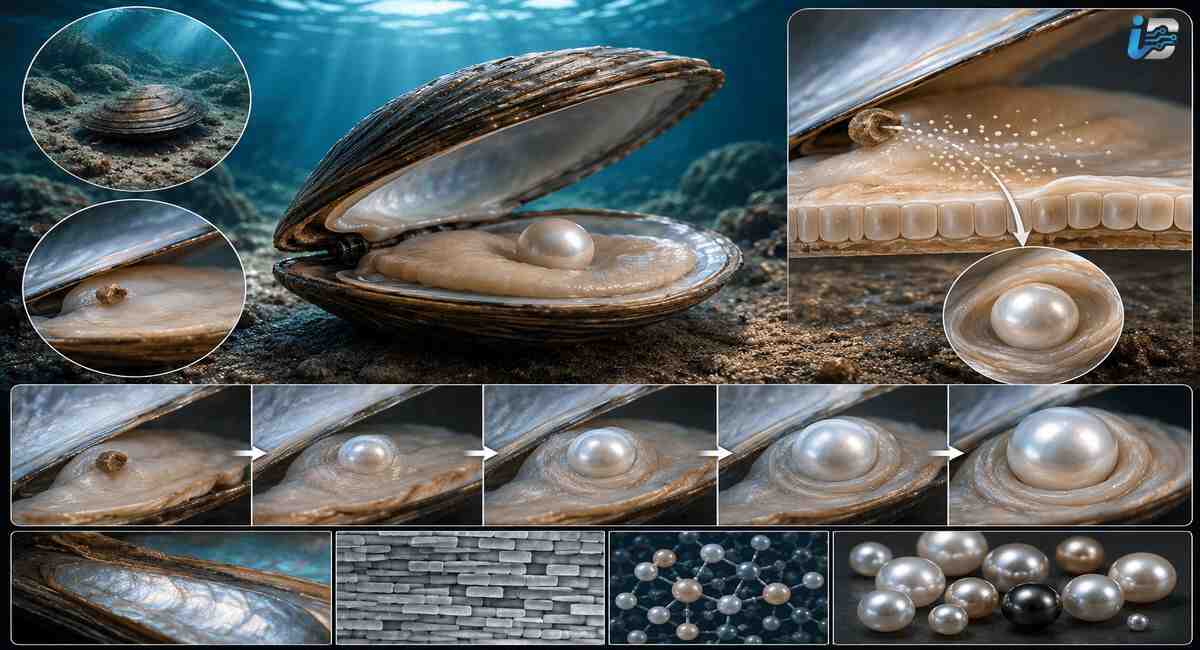
If you’ve ever bitten into a plate of steamed clams and felt something hard and gritty that definitely wasn’t shell, you’ve probably wondered the same thing thousands of diners have wondered before you: why do clams have pearls in the first place? The short answer is defense. A clam doesn’t grow a natural pearl to look pretty — it grows one to survive. When sand, a parasite, or a stray shell fragment slips inside its soft tissue, the clam responds the only way it can: by wrapping the irritant in layer after layer of calcium carbonate until the threat is sealed away. What’s left behind is one of the few gems on Earth made entirely by a living animal, and understanding why clams have pearls tells you almost everything about why some are dazzling and others are, frankly, kind of ugly.
What Makes a Clam Produce a Pearl
A pearl isn’t a reproductive structure or a decorative trait — it’s a biological defense mechanism. Clams, like all bivalve mollusks, have a soft body protected by two hinged shells made of calcium carbonate. When something foreign works its way past that armor, the clam can’t just spit it out the way you or I might handle a splinter.
Instead, specialized cells in the mantle tissue — the thin, fleshy lining between the clam’s body and its shell — trigger what’s essentially an immune response. Those cells surround the intruder and begin secreting the same shell-building material the clam uses to grow and repair its own exoskeleton, only this time it’s building around something trapped inside.
The Nacre Difference: Why Most Natural Clam Pearl Don’t Shine
Here’s the part most articles gloss over. Not every pearl is made of nacre, also known as mother-of-pearl, and that single fact explains almost every quality difference you’ll ever see between pearls. Nacre is built from aragonite crystals stacked in thin, interlocking tablets, and it’s that microscopic crystalline structure that produces the glowing, rainbow-like iridescence prized in fine jewelry.
Most edible clams — the littlenecks, cherrystones, and quahogs you’d order at a seafood restaurant — don’t have nacreous inner shells. Their pearls are made of calcite instead, which is chemically similar but structurally duller. The result is a calcareous concretion: technically a pearl, but with a matte, chalky look instead of that classic luster. Oysters and a handful of freshwater mussels are the real nacre producers, which is exactly why cultured oyster pearls dominate the jewelry industry.
How the Pearl-Forming Process Actually Works
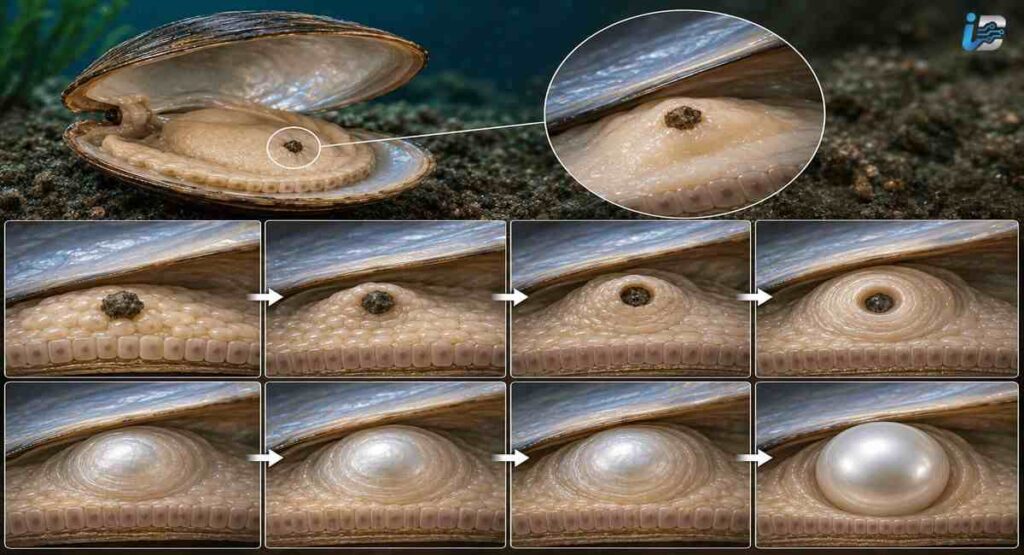
Pearl formation isn’t instant. Once an irritant becomes lodged in the mantle, the clam’s cells form what’s called a pearl sac around it, then begin depositing material in concentric layers, much like the rings of a tree. Depending on the species and conditions, this process can take anywhere from several months to multiple years.
Each layer hardens before the next is added, gradually building outward until the intruder is fully encased. In nacre-producing species, alternating layers of aragonite and a protein called conchiolin create the shimmering optical effect. In non-nacreous clams, the layering still happens, but without that same crystalline order, so the finished pearl looks more like polished stone than a glowing gem.
Which Clams Can Actually Produce Pearls
Technically, almost any bivalve mollusk can form a pearl if conditions are right, but not all of them are equally likely to. Quahog clams (Mercenaria mercenaria) are the most commonly reported source of clam pearls in North America, typically producing small white, brown, or occasionally purple pearls.
Littleneck and Manila clams can technically produce them too, but confirmed finds are considered rarer and less documented than quahog pearls. None of these everyday clam species produce nacreous pearls, which is the main reason clam pearls rarely show up in fine jewelry the way oyster pearls and mussel pearls do.
Giant Clams and the World’s Largest Pearls
If you want to see what a clam pearl looks like at its most extreme, look at Tridacna gigas, the giant clam. These massive Indo-Pacific mollusks can grow up to four feet across and live for a century, and they’re responsible for the largest pearls ever documented.
The most famous example, the so-called Pearl of Allah, was found off the Philippines in 1934, measuring roughly 9.4 inches long and weighing about 14 pounds. Tridacna pearls like this one have a distinctive porcelaneous surface, sometimes with a striking flame pattern, but because they’re non-nacreous, gemologists classify them differently from traditional gem-quality pearls, and headline valuations in the tens of millions are largely unverified internet legend rather than confirmed sales.
A more recent giant Tridacna pearl, discovered by a fisherman in Palawan, Philippines, and kept under his bed for a decade, made headlines when it resurfaced after a house fire. Viral estimates put its worth as high as $100 million, but gemologists and pearl dealers who’ve examined similar specimens note that verified sales of Tridacna pearls typically land in the thousands to low tens of thousands of dollars, since non-nacreous pearls are priced on rarity and pattern rather than the brilliance that drives traditional pearl markets.
How Rare Is It to Find a Pearl in a Clam
This is the question most people are really asking, and the honest answer is: it depends heavily on the species. Reported odds for quahog clams run around one in 5,000 shells, while common edible clams used in restaurants are often cited closer to one in 10,000. Compare that to oysters, where the odds of finding any pearl at all are similarly long, and it’s clear why a clam pearl discovery makes local news.
Most of these accidental finds are small, irregularly shaped, and commercially worthless. But every so often, someone bites into real luck — like the Pennsylvania man who found a purple quahog pearl at a Delaware restaurant in 2022, later appraised between $10,000 and $16,000.
Are Clam Pearls worth Anything
Value comes down to three things: size, color, and nacre content. A pearl smaller than about 5 millimeters or lighter than half a gram typically has little to no resale value, regardless of how exciting the discovery felt. Larger, well-shaped, vividly colored specimens — especially purple or lavender quahog pearls — can fetch real money at auction, sometimes thousands of dollars.
Giant clam Tridacna pearls occupy their own category entirely. Because they’re non-nacreous, they’re valued more for size, rarity, and pattern than for the brilliance that drives oyster pearl pricing, and serious sales are documented in the thousands to low tens of thousands of dollars rather than the eye-popping figures that circulate online.
Clam Pearls vs. Oyster Pearls
The biggest misconception is that all pearls are basically the same gem from different animals. In reality, clam pearls and oyster pearls diverge sharply. Oyster and many freshwater mussel pearls are built from nacreous layers, giving them the smooth, reflective luster associated with Akoya pearls, South Sea pearls, and freshwater cultured pearls sold in jewelry stores.
Clam pearls, outside of rare nacre-producing exceptions, are non-nacreous and matte. That doesn’t make them worthless or uninteresting — it just makes them a different category of natural curiosity, prized more for rarity and story than for the mirror-like shine buyers expect from traditional pearl jewelry.
What to Do If You Find a Pearl in Your Clam
First, don’t clean it aggressively or expose it to heat — both can crack the surface or dull its color permanently. Rinse it gently in cool water and pat it dry. Next, note the clam species if you know it, along with the size and weight, since both factor heavily into value.
From there, a qualified jeweler or gemological lab can identify whether it’s nacreous or calcareous and give you a realistic appraisal. Even if it turns out to be commercially worthless, it’s still a genuinely rare natural event worth keeping as a conversation piece — or the start of a custom pendant or ring.
FaQs
Are pearls from clams worth anything?
Only if they’re a decent size and color — most are tiny and worthless, but rare large or purple quahog pearls can sell for thousands.
Is it rare to find pearls in a clam?
Yes — roughly 1 in 5,000 for quahogs and closer to 1 in 10,000 for common edible clams.
Does it hurt clams to remove pearls?
The clam is already dead (opened for eating or harvesting) by the time the pearl is removed, so no additional harm occurs at that point.
What is the purpose of pearls in clams?
They’re a defensive response — the clam seals off a trapped irritant like sand or a parasite in protective layers.
How much is a single clam pearl worth?
Most are worth nothing, but a notable one can range from a few hundred to tens of thousands of dollars depending on size, color, and rarity.
Are oysters killed to remove pearls?
In commercial pearl farming, most nucleated oysters survive the process and can be reused, though wild/natural pearl harvesting typically involves shucking the oyster for food or the pearl.
Why do clams have pearls in the first place?
The core reason why clams have pearls comes down to defense: sand, a parasite, or shell debris gets trapped inside their soft tissue, and layers of protective material seal it off over time.
Are pearls found in clams real pearls?
Yes, technically. However, most are non-nacreous calcareous concretions rather than the nacre-based pearls associated with fine jewelry.
How rare is it to find a pearl in a clam?
Estimates vary by species, but quahog clams are often cited around one in 5,000, while common edible clams are closer to one in 10,000.
Do all clams make pearls?
Any bivalve mollusk can theoretically produce one, but confirmed pearls are mostly reported in quahog clams and, at the extreme size end, giant Tridacna clams.
Can you sell a pearl found in a clam?
Yes, if it meets a minimum size and quality threshold. Small, dull, or misshapen pearls typically have no resale value, while larger colorful ones can be appraised and sold.
Where Do You Find Clams with Pearls?
Clams with pearls are found in freshwater rivers and lakes, as well as warm coastal oceans where pearl-producing mollusks naturally live.
How Many Pearls Can a Clam Make?
A clam can produce more than one pearl, but most clams never make any pearls at all. In rare cases, a single clam may contain several pearls, though only one or two are usually of good quality.
Do Giant Clams Make Pearls?
Yes, giant clams can produce pearls, but they are extremely rare and are typically non-nacreous (without the shiny coating found on oyster pearls). These pearls are uncommon and have limited commercial value.
Conclusion
So, why do clams have pearls? Because a pearl is never really about beauty to the clam that makes it — it’s survival, layer by layer, wrapped around whatever shouldn’t be there. That defensive origin is exactly what makes clam pearls so unpredictable: some are dull, chalky, and worthless, while others, like a rare purple quahog find or a giant Tridacna specimen, become genuine treasures. The next time you crack into a plate of clams and feel something unexpected, you’ll know exactly what’s happening inside that shell — and whether it’s worth a second look.

Welcome to Infoz Style I am Karl Braun ,an Ai – powered SEO , and Content Writer With 4 Years of experience. I help Websites Rank higher , grow traffic , and look amazing . My goal is to make SEO and Web design simple and effective for everyone.
Let`s achieve more together !
1 thought on “Why Do Clams Have Pearls? The Science Behind Nature’s Gems”