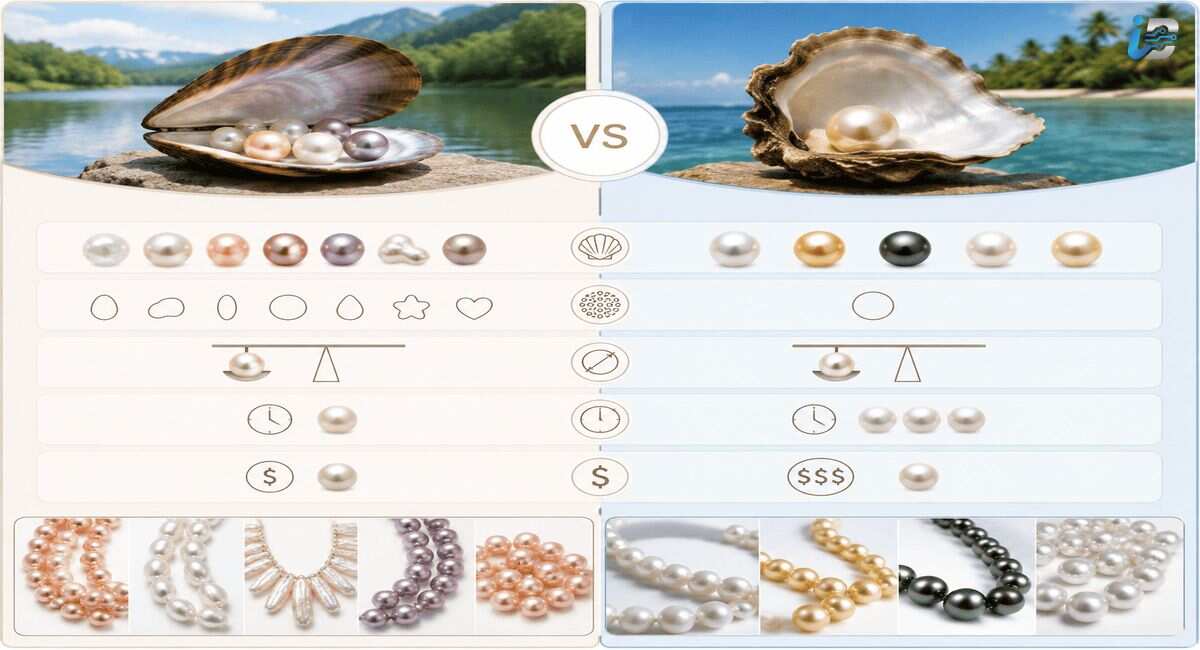
When comparing mussel pearls vs oyster pearls, understanding how each pearl forms is essential for making the right jewelry choice. Freshwater mussels produce pearls in lakes and rivers, while pearl oysters create pearls in oceans and seas. Although both are genuine cultured pearls, they differ in appearance, luster, size, durability, rarity, and price.
Mussel pearls are known for their affordability, thick nacre, and wide variety of colors and shapes, whereas oyster pearls are prized for their exceptional shine, roundness, and luxury appeal. This guide explores the key differences between these two pearl types, helping you choose the perfect pearl jewelry based on your budget, style, and long-term value.
What Are Freshwater Pearls and Saltwater Pearls?
The main difference between Freshwater Pearls and Saltwater Pearls is their origin. Freshwater Pearls grow inside a Freshwater Mussel in lakes and rivers, while Saltwater Pearls form inside a Pearl Oyster in oceans. Both belong to the Mollusk family, but their environment affects their quality and value.
Chinese Freshwater Pearls dominate global Pearl Production, making them more affordable. In contrast, Japanese Pearls, including Akoya Pearls, are known for their premium quality. Other famous Ocean Pearls include South Sea Pearls, Tahitian Pearls, and rare Biwa Pearls, with additional pearl farms located in Fiji and Mexico.
How Freshwater Pearls Are Formed
Freshwater Pearls are produced through Freshwater Cultivation, where a small piece of Mantle Tissue or Tissue Graft is inserted into a Freshwater Mussel using Tissue Nucleation, usually without a Bead Nucleus.
The mussel begins Nacre Secretion, forming layers of Nacre made from Calcium Carbonate that gradually create a durable pearl. Mussels develop from Larvae to Juvenile Mussels after attaching to a Fish Host. During the Pearl Culturing Process, one mussel can produce multiple pearls, resulting in efficient farming, attractive colors, excellent Pearl Surface Quality, and long-lasting durability.
How Saltwater Pearls Are Formed
Unlike freshwater pearls, Saltwater Pearls grow inside a marine Pearl Oyster through a more delicate cultivation process known as Saltwater Cultivation.
During Oyster Grafting, skilled technicians carefully place a polished Bead Nucleus together with a small piece of Mantle Tissue inside the oyster’s Gonad. This procedure begins the natural Pearl Formation process. The oyster responds by slowly covering the nucleus with thin layers of Mother of Pearl, creating the brilliant glow that makes marine pearls so desirable.
Young oysters begin life as Oyster Spat, which are first raised in a specialized Pearl Hatchery before being transferred into protected ocean farms. Throughout the Pearl Growth period, farmers carefully monitor water quality, temperature, ocean currents, and overall oyster health.
Since each oyster generally produces only one pearl during a cultivation cycle, Pearl Harvesting requires years of patience and careful management. This limited production contributes to the higher Saltwater Pearl Value, making premium varieties highly sought after for Luxury Jewelry and Investment Pearls.
Freshwater Pearls vs Saltwater Pearls: The Main Differences
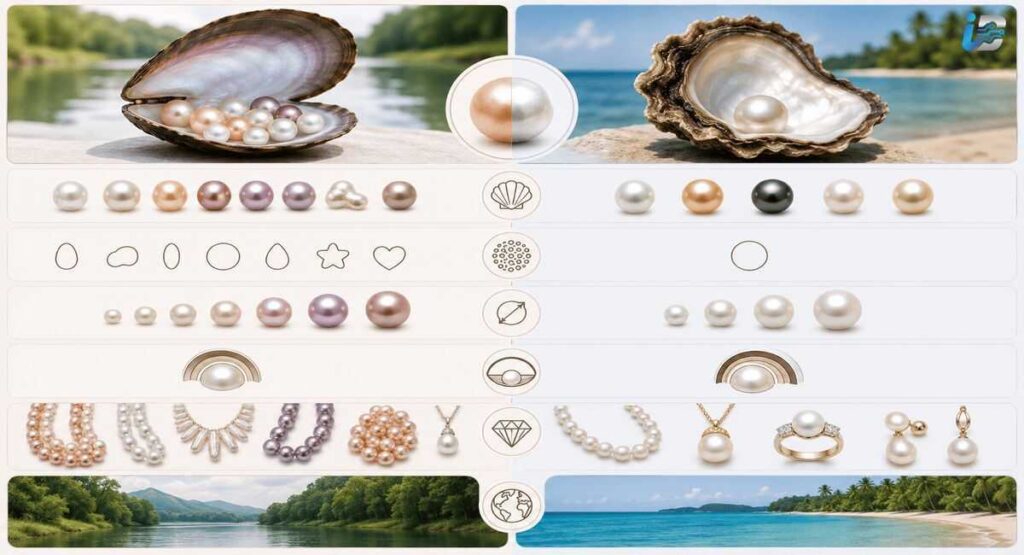
Although both are genuine Cultured Pearls, their farming methods create noticeable differences.
| Feature | Freshwater Pearls | Saltwater Pearls |
| Water Source | Lakes, Rivers, Ponds | Oceans and Seas |
| Host | Freshwater Mussel | Pearl Oyster |
| Cultivation | Freshwater Cultivation | Saltwater Cultivation |
| Nucleation | Tissue Nucleation | Bead Nucleus with tissue |
| Production | Multiple pearls per mussel | Usually one pearl per oyster |
| Price | Lower | Higher |
| Best For | Everyday jewelry | Luxury collections |
One of the biggest differences is Pearl Luster. Saltwater Pearls often display brighter reflections, smoother surfaces, and nearly perfect roundness because marine oysters deposit extremely even layers of nacre. Meanwhile, Freshwater Pearls offer greater variety in shape, color, and size while providing exceptional durability due to their thick nacre composition.
Another important distinction is affordability. Since freshwater mussels produce many pearls simultaneously, Freshwater Pearl Price is generally much lower than Saltwater Pearl Price. This makes freshwater pearls an excellent choice for buyers looking for beautiful, high-quality jewelry at a more affordable price.
Natural vs Cultured Pearls
Many people believe Cultured Pearls are artificial, but this is one of the biggest misconceptions about pearls. In reality, Cultured Pearls are genuine pearls produced inside living mollusks. The only difference is that humans carefully begin the process by inserting a Mantle Tissue, Tissue Graft, or Bead Nucleus. After that, nature takes over completely. The mollusk naturally performs Nacre Secretion, gradually forming beautiful layers of Nacre made from Calcium Carbonate, just as it would in the wild.
In contrast, Natural Pearls form without any human assistance. A natural irritant enters a wild oyster or mussel, triggering the Pearl Formation process. Because this happens so rarely today, authentic Natural Pearls have become extremely scarce and valuable. Most pearl jewelry sold worldwide now consists of high-quality Cultured Pearls, offering the same beauty, durability, and elegance at a much more affordable price while helping protect wild mollusk populations.
Types of Saltwater Pearls
Not all Saltwater Pearls are the same. Different oyster species and growing environments produce pearls with unique sizes, colors, and levels of Pearl Luster. Understanding these famous varieties helps explain why some pearls are considerably more valuable than others.
Akoya Pearls
Among all marine pearls, Akoya Pearls are considered the classic choice for elegant jewelry. These famous Japanese Pearls are cultivated mainly around Japan’s coastal waters and are admired for their exceptional Pearl Luster, near-perfect Roundness, and smooth Pearl Surface Quality.
Most Akoya Pearls measure between 6 and 9 mm and display beautiful white, cream, silver, or rose overtones. Because each Pearl Oyster usually produces only one pearl, these gems remain highly desirable for bridal jewelry, fine necklaces, and luxury earrings.
South Sea Pearls
South Sea Pearls are among the world’s most luxurious pearls. Cultivated primarily in Australia, Indonesia, and the Philippines, they grow inside one of the largest marine oysters. Their extended Pearl Growth period allows thick Mother of Pearl layers to develop, producing outstanding beauty and remarkable durability.
These pearls often range from 10 to 20 mm, making them significantly larger than most other pearl varieties. Their elegant white, silver, and golden shades make them highly prized for premium Luxury Jewelry and heirloom collections.
Tahitian Pearls
Known for their dramatic appearance, Tahitian Pearls are cultivated in French Polynesia inside the black-lipped Pearl Oyster. Unlike traditional white pearls, they naturally display black, charcoal, green, blue, purple, and peacock tones.
Each pearl develops unique overtones, making every piece one of a kind. Combined with exceptional Pearl Luster, their exotic beauty has made Tahitian Pearls one of the most sought-after choices for collectors and designers creating modern statement jewelry.
Sea of Cortez Pearls
Among the rarest Ocean Pearls, Sea of Cortez Pearls come from Mexico and are produced in extremely limited quantities. They are famous for their naturally iridescent colors that shift between bronze, green, silver, violet, and rainbow hues depending on the light.
Because of their rarity and limited Pearl Production, these pearls are often regarded as premium Investment Pearls, attracting collectors looking for exclusive gemstones with exceptional beauty.
Why Freshwater Pearls and Saltwater Pearls Are Different
Although both pearls are created by living Mollusk species, several biological and environmental factors influence their appearance, durability, and overall Pearl Quality.
Differences in Nacre
The most important factor affecting pearl quality is Nacre, also known as Mother of Pearl or Mother-of-Pearl. This natural substance consists mainly of microscopic layers of Calcium Carbonate that create a pearl’s signature glow.
Since Freshwater Pearls usually develop through Tissue Nucleation without a large Bead Nucleus, they contain solid nacre throughout the entire pearl. This gives them excellent Pearl Durability and outstanding resistance to everyday wear.
By comparison, Saltwater Pearls form around a Bead Nucleus. Marine oysters produce extremely even nacre layers, resulting in brighter reflections, smoother surfaces, and exceptional Pearl Luster. This explains why premium Akoya Pearls, South Sea Pearls, and Tahitian Pearls often exhibit a mirror-like shine.
Differences in Farming
Modern Pearl Farming combines science with nature. During Freshwater Cultivation, healthy mussels are raised in lakes where efficient Mussel Farming allows dozens of pearls to develop simultaneously. Farmers closely monitor water quality, nutrition, and shell health throughout the Pearl Culturing Process, ensuring consistent Pearl Production while keeping costs affordable.
Marine farming is considerably more delicate. During Saltwater Cultivation, trained technicians perform Oyster Grafting, inserting a Bead Nucleus and Mantle Tissue into each oyster. Since each oyster usually produces only one pearl, the entire cultivation cycle requires significantly more time, labor, and investment. These factors largely explain the higher Saltwater Pearl Price.
Differences in Appearance
Appearance is one of the easiest ways to compare Freshwater Pearls and Saltwater Pearls.
Freshwater Pearls naturally occur in many shapes, including round, oval, button, rice, teardrop, and baroque forms. Their colors range from white and cream to pink, peach, lavender, and purple, making them highly versatile for fashion jewelry.
In contrast, Saltwater Pearls are known for their near-perfect symmetry, smoother Pearl Surface, and brilliant Pearl Luster. Depending on the oyster species, they appear in white, cream, silver, gold, black, and peacock shades, making them a favorite for elegant and formal jewelry collections.
Environmental Factors
Environmental conditions significantly influence Pearl Development. Freshwater farms rely on clean lakes and rivers where healthy Freshwater Mussel populations thrive. Essential minerals such as Calcium and Manganese support strong shell growth and healthy Mother of Pearl formation.
Meanwhile, ocean farms face additional challenges, including changing tides, storms, predators, and fluctuating temperatures. Farmers continuously monitor these conditions because healthy oysters produce thicker nacre, stronger Pearl Composition, and better overall Gem Quality Pearls.
Which Offers Better Pearl Quality and Value?
There is no single winner between Freshwater Pearls and Saltwater Pearls. The best choice depends on your budget, style, and personal preference. Freshwater Pearls provide excellent value, and improvements in Freshwater Cultivation have significantly enhanced Freshwater Pearl Quality while keeping prices affordable.
Saltwater Pearls are valued for their exceptional Pearl Luster, smooth Pearl Surface Quality, limited Pearl Production, and higher Saltwater Pearl Value, making them ideal for Luxury Jewelry and heirloom pieces. Professional jewelers assess pearls based on Pearl Luster, Pearl Surface, Pearl Shape, Pearl Size, Pearl Composition, and nacre thickness, proving that overall quality is more important than origin.
Freshwater or Saltwater Pearls: Which Should You Choose?
Choosing between Freshwater Pearls and Saltwater Pearls depends on your budget, lifestyle, and personal preferences rather than simply selecting the more expensive option. Both are genuine Cultured Pearls created through the natural Pearl Formation process, and each offers unique advantages.
If you are shopping for your first pearl necklace or looking for elegant jewelry that can be worn daily, Freshwater Pearls are an excellent choice. Thanks to improvements in Freshwater Cultivation, modern Chinese Freshwater Pearls now feature impressive Pearl Luster, smoother Pearl Surface Quality, and better Roundness than ever before. Their thick Nacre provides excellent Pearl Durability, making them ideal for everyday wear while remaining highly affordable.
On the other hand, buyers seeking timeless elegance often prefer Saltwater Pearls. Premium Akoya Pearls are famous for their mirror-like shine, while South Sea Pearls offer exceptional size and luxurious beauty. Those looking for bold and unique jewelry frequently choose Tahitian Pearls, which naturally display stunning dark colors. Because marine oysters produce only one pearl during each Pearl Culturing Process, these pearls are rarer and command a higher Saltwater Pearl Price, making them popular as Investment Pearls and treasured family heirlooms.
How to Identify Genuine Pearls
Whether you buy Freshwater Pearls or Saltwater Pearls, knowing how to identify genuine pearls helps you avoid imitations. Authentic pearls show natural variations in Pearl Shape, Pearl Color, and Pearl Surface, while their deep Pearl Luster reflects light beautifully. Real pearls also feel cool at first and become warm against the skin.
Their fine texture, created by Nacre Secretion, gives a slightly gritty feel during the traditional Tooth Test. For expensive purchases, choose certified pearls, as professional jewelers assess Pearl Luster, Pearl Surface Quality, Pearl Composition, Pearl Weight, Pearl Size, nacre thickness, and Gem Quality Pearls standards to verify authenticity.
Common Signs of Fake Pearls
Imitation pearls often reveal several warning signs. Plastic pearls usually feel unusually light, while inexpensive coated beads may peel around drill holes after regular use. Their artificial shine lacks the depth created by genuine Mother of Pearl, making them appear overly glossy instead of naturally radiant.
Perfect uniformity can also indicate imitation jewelry. Since every Freshwater Mussel and Pearl Oyster develops pearls differently, authentic pearls normally show tiny differences in color, size, or surface texture. Buying from trusted jewelers who guarantee authenticity is the best way to avoid counterfeit pearls.
Caring for Freshwater Pearls and Saltwater Pearls
Proper care helps maintain the beauty and Pearl Value of both Freshwater Pearls and Saltwater Pearls. Their Nacre surface is delicate, so avoid contact with perfumes, cosmetics, household cleaners, chlorine, and other chemicals that can damage Mother-of-Pearl and reduce Pearl Luster. After wearing pearl jewelry, gently wipe each pearl with a soft cloth.
Clean pearls using a damp microfiber cloth and mild soap, avoiding steam or ultrasonic cleaners to protect Pearl Surface Quality and Pearl Durability. Store pearls separately in a soft pouch or lined jewelry box to prevent scratches, and have frequently worn pearl necklaces restrung every one or two years.
FaQs
Are mussel pearls valuable?
Yes, mussel pearls are valuable, and their value depends on their luster, size, shape, surface quality, and overall quality.
What is the highest quality pearl?
South Sea Pearls are considered the highest-quality pearls because of their exceptional size, luster, rarity, and premium appearance.
Is it rare to find a pearl in a mussel?
Yes, finding a natural pearl inside a wild mussel is extremely rare because most pearls available today are cultured pearls.
Do pearls come from mussels or oysters?
Pearls come from both freshwater mussels and saltwater oysters, depending on the type of pearl.
Why can’t you wear pearls in water?
Chlorinated or salt water can damage the nacre, reducing a pearl’s natural luster over time.
How long does it take for a mussel to make a pearl?
A freshwater mussel usually takes 2 to 6 years to produce a cultured pearl, depending on the farming conditions.
Conclusion
Understanding the differences between Freshwater Pearls and Saltwater Pearls helps you choose the right pearl jewelry with confidence. Freshwater Pearls are valued for their affordability, thick Nacre, durability, and variety, while Saltwater Pearls are known for their exceptional Pearl Luster, smooth Pearl Surface, rarity, and elegance. Both are genuine Cultured Pearls, making the best choice dependent on your budget and style.
Before buying, compare Pearl Quality based on Pearl Luster, Pearl Surface Quality, Pearl Shape, Pearl Size, Pearl Composition, nacre thickness, and craftsmanship. Whether you choose Chinese Freshwater Pearls, Japanese Pearls, South Sea Pearls, Tahitian Pearls, Biwa Pearls, or Sea of Cortez Pearls, proper care will preserve their beauty and value for years.

Welcome to Infoz Style I am Karl Braun ,an Ai – powered SEO , and Content Writer With 4 Years of experience. I help Websites Rank higher , grow traffic , and look amazing . My goal is to make SEO and Web design simple and effective for everyone.
Let`s achieve more together !