
Learning how to check if pearls are real is important because many fake pearls look surprisingly similar to real pearls at first glance. When you understand proper pearl identification, you can easily avoid low-quality imitation pearls and make smarter jewelry choices. Real pearls show natural glow, slight imperfections, and unique pearl texture, while fake ones often look too perfect or overly shiny.
By studying pearl luster, weight, and surface quality, you can quickly judge authenticity. Whether you are buying pearl jewelry, a pearl necklace, or secondhand pieces, knowing these signs helps you confidently spot genuine treasures and avoid costly mistakes.
What Makes a Pearl Real? Understanding Natural and Cultured Pearls
A pearl is considered real pearls when it forms inside a mollusk like an oyster or clam, where pearl formation occurs naturally. In this process, layers of nacre gradually build around a tiny irritant, creating the soft glow known as iridescence. Both natural and cultured pearls contain genuine nacre, which is why jewelers classify them as authentic gems rather than artificial products.
When comparing natural vs cultured pearls, the key difference is human assistance in inserting a nucleus, but the mollusk still produces nacre naturally. This makes both types organic gemstones with genuine beauty and lasting pearl value in the jewelry market.
How Natural Pearls Form
Natural pearls form without human involvement. A foreign particle enters the mollusk and triggers a defensive response. Over many years, nacre layers build up naturally. Because this process is rare, natural pearls often command higher prices than cultured varieties.
How Cultured Pearls Are Created
Cultured pearls begin when pearl farmers carefully place a nucleus into the mollusk. The creature then covers it with nacre. The result is a real pearl that develops through the same biological process found in nature.
Why Cultured Pearls Are Still Considered Real
Many consumers mistakenly believe cultured pearls are fake. In reality, the nacre forms naturally. Experts in Jewelry authentication and Fine jewelry appraisal recognize cultured pearls as genuine gemstones.
The Role of Nacre in Pearl Authenticity
Nacre determines much of a pearl’s beauty and durability. Greater nacre thickness often leads to stronger pearl durability, richer glow, and better long-term value.
Real Pearls vs Fake Pearls: Key Differences You Should Know
The easiest way to understand real pearls vs fake pearls is to study their surface. Genuine pearls display tiny imperfections because nature rarely creates perfect symmetry. Their glow appears deep and multidimensional. In contrast, many imitation pearls have a uniform appearance that lacks natural complexity.
Another important difference involves touch. Authentic pearls feel cool when first placed against the skin. They also show subtle irregularities in pearl texture. Fake pearls often feel smooth and lightweight. Understanding these distinctions can help you learn how to know if pearls are genuine before making a purchase.
Appearance and Surface Characteristics
Real pearls reveal natural growth marks and slight variations. These unique details improve pearl surface quality and indicate authenticity rather than flaws.
Texture and Feel
One of the most trusted methods involves examining pearl texture. Genuine pearls feel slightly gritty while fake versions feel slick and glassy.
Weight and Density
Authentic pearls often feel heavier than plastic imitations. Their density comes from layers of nacre created during growth.
Luster and Light Reflection
True pearls display remarkable pearl luster. Light seems to come from within the gem rather than merely reflecting off the surface.
Durability and Longevity
Because of their nacre layers, genuine pearls offer greater pearl durability than most imitation alternatives.
Price and Market Value
Although not always reliable, price can provide clues. Extremely cheap strands claiming to be luxury pearls often deserve closer inspection.
Quick Comparison Chart: Genuine Pearls vs Imitation Pearls
A comparison chart helps simplify pearl inspection. While no single factor guarantees authenticity, several indicators together can reveal whether pearls are genuine or imitation. Experienced jewelers rely on multiple tests rather than one isolated observation.
When buyers evaluate luxury pearl jewelry, they often examine luster, weight, shape, and nacre quality. These characteristics help determine both authenticity and overall value.
| Feature | Genuine Pearls | Imitation Pearls |
| Surface | Slight imperfections | Perfectly smooth |
| Luster | Deep and reflective | Artificial shine |
| Weight | Heavier | Often lighter |
| Temperature | Cool initially | Room temperature |
| Texture | Slightly gritty | Smooth |
| Durability | Strong nacre layers | Coating may peel |
| Value | Higher resale value | Lower resale value |
| Lifespan | Decades with care | Often shorter |
Side-by-Side Comparison Benefits
This chart provides a quick overview for buyers researching how to test pearls for authenticity. It combines several factors into one easy reference.
8 Proven Ways to Tell If Pearls Are Real at Home
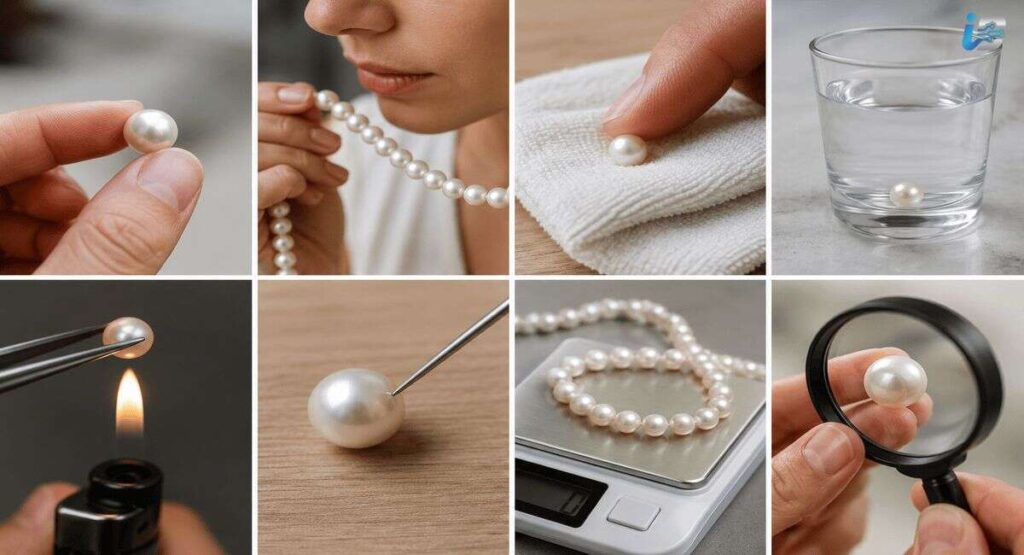
Learning how to identify real pearls at home can save both time and money. Several simple methods require no special equipment. While these tests cannot replace professional evaluation, they often reveal clear signs of authenticity.
Many experts recommend combining several tests rather than relying on only one. A pearl that passes multiple examinations is more likely to be genuine. This approach reduces the chance of misidentification and improves confidence during purchasing decisions.
The Tooth Test
The famous pearl tooth test remains one of the oldest authentication methods. Gently rub a pearl across the edge of your teeth. Genuine pearls feel slightly rough because of microscopic nacre layers.
Examine the Surface Texture
A close inspection often reveals natural growth marks. Authentic pearls rarely appear perfectly flawless. Small irregularities support positive pearl identification.
Check the Pearl Luster
The pearl luster test evaluates how light reflects from the pearl. Real pearls display a deep glow with visible reflections beneath the surface.
Inspect the Drill Holes
Drill holes provide valuable clues. On genuine pearls, the nacre usually appears clean and consistent around the opening. Peeling edges may indicate imitation pearl coatings.
Compare Weight and Density
Authentic pearls generally feel denser than plastic imitations. This simple comparison often helps shoppers identify suspicious pieces.
Perform the Temperature Test
Real pearls feel cool against the skin at first. They gradually warm as they absorb body heat. Many fake pearls lack this characteristic.
Use Magnification for Close Inspection
A jeweler’s loupe can reveal surface details invisible to the naked eye. Tiny ridges and natural imperfections often indicate authenticity.
Rub Two Pearls Together
Another version of the genuine pearl test involves rubbing two pearls lightly together. Genuine pearls create a subtle powder from nacre friction while remaining undamaged.
“No single test is perfect. The most accurate results come from combining multiple authentication methods.”
| Home Test | Real Pearl Result | Fake Pearl Result |
| Tooth Test | Slightly gritty | Smooth |
| Luster Test | Deep glow | Flat shine |
| Temperature Test | Cool initially | Neutral temperature |
| Magnification | Natural imperfections | Uniform surface |
| Weight Test | Dense feeling | Lightweight |
Understanding these methods makes it much easier to answer questions such as How can you tell if pearls are real?, What do fake pearls look like?, and Do real pearls feel gritty?. More importantly, these techniques provide practical knowledge that helps buyers make smarter jewelry decisions.
Common Types of Fake Pearls and How to Recognize Them
Fake pearls often try to copy the glow of real pearls, but they usually fail under close inspection. Many imitation pearls use plastic, glass, or coated beads. At first glance, they may look like fine jewelry, yet their surface often lacks depth and natural pearl luster. Once you understand their structure, spotting them becomes much easier.
Another key point is aging behavior. Real pearls improve slightly with proper pearl care, while fake ones often degrade. Their coating may peel or fade over time. This difference becomes very obvious in long-term wear, especially in pearl necklaces or pearl strands used daily.
Plastic Pearls
Plastic pearls are the most common fake type. They feel extremely light and warm quickly. Their pearl texture is too smooth and uniform. They rarely show any natural flaws, which makes them easy to identify.
Glass Pearls
Glass pearls look better than plastic versions. However, they often feel heavier than real pearls. Their shine looks sharp instead of soft, which reduces natural pearl surface quality.
Shell Pearls
Shell pearls are made from crushed shell material and coated for shine. They can mimic cultured pearls, but their coating often chips with time. This damage exposes their artificial core.
Coated Imitation Pearls
These pearls use a painted or synthetic coating over a base bead. They often look attractive in costume jewelry, but they fail under pearl inspection because the coating wears off easily.
Different Types of Real Pearls Explained
Real pearls come in different forms depending on where they grow. Each type has unique beauty, value, and origin. Understanding these differences helps buyers choose better authentic pearls and avoid confusion with fakes.
The most important factor in pearl identification is origin. Whether it is Freshwater pearls, Saltwater pearls, or exotic varieties like Tahitian pearls, each type carries its own charm and market demand. These pearls are widely used in luxury pearl jewelry and high-end designs.
Freshwater Pearls
Freshwater pearls come from rivers and lakes. They are often more affordable but still completely real. They are widely used in pearl earrings and casual jewelry designs.
Akoya Pearls
Japanese pearls or Akoya pearls are famous for their perfect round shape and sharp pearl luster. They are highly valued in classic pearl necklaces.
Tahitian Pearls
Tahitian pearls are known for dark exotic colors. They are rare and often used in luxury designs. Their deep tones increase their pearl value significantly.
South Sea Pearls
Saltwater pearls like South Sea pearls are among the largest and most expensive. They are prized for their thick nacre and rich glow.
How to Check If a Pearl Necklace Is Authentic
A pearl necklace or pearl strand requires more than just surface checking. The stringing method, knots, and metal parts all reveal authenticity. High-quality pieces often use hand-knotted pearls, which protect each pearl from friction and damage.
Professional jewelers also examine pearl settings. If pearls are set in Sterling silver, White gold, or Diamond settings, there is a higher chance they are genuine. Cheap materials often indicate fake pearls or costume jewelry.
Clasp and Metal Inspection
The clasp tells a lot about quality. Authentic necklaces often use strong, well-finished clasps designed for long-term wear.
Knotting Between Pearls
Knots between pearls prevent damage and indicate careful craftsmanship. This technique is common in high-quality fine jewelry.
Matching and Uniformity
Slight differences in size and shape are normal. Perfect uniformity can sometimes indicate imitation production.
| Feature | Authentic Necklace | Fake Necklace |
| Knotting | Present | Often missing |
| Weight | Balanced | Uneven or light |
| Luster | Natural glow | Artificial shine |
| Durability | High | Low |
How to Tell If Vintage or Thrift Store Pearls Are Real
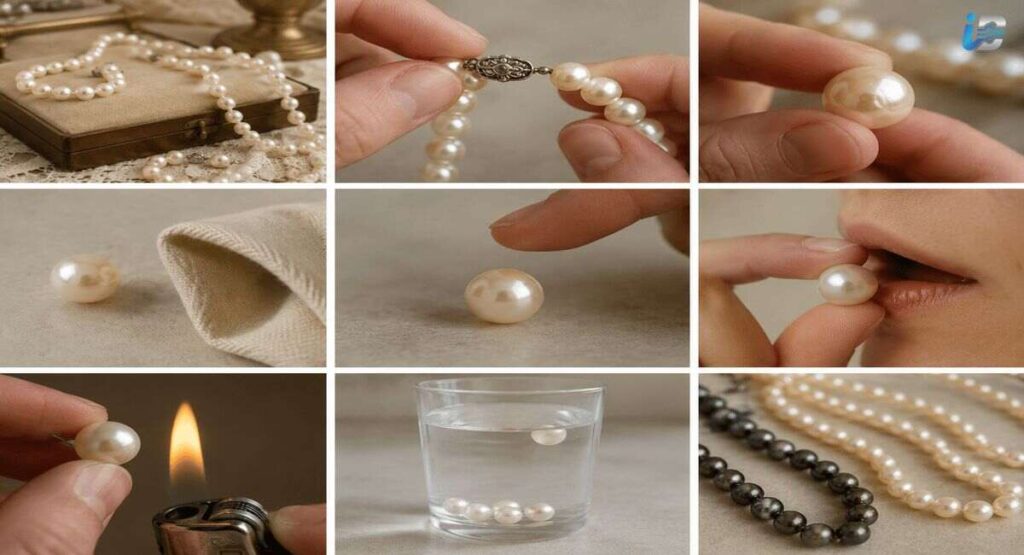
Buying vintage pearls or secondhand pearls can be exciting. Many hidden treasures appear in thrift stores, estate sales, and auctions. However, buyers often ask, are thrift store pearls real? The answer is yes, but careful inspection is necessary.
Older pieces often contain seed pearls or antique designs from Victorian jewelry and Art Nouveau jewelry eras. These pearls may look different from modern ones, but they are often genuine and valuable if properly verified.
Identifying Antique Pearl Jewelry
Antique pieces often show hand craftsmanship. Slight irregularities and aged metal settings can indicate authenticity.
Evaluating Estate Sale Finds
Estate jewelry sometimes includes high-value designer jewelry or rare antique jewelry pieces. Always check for hallmarks and craftsmanship.
Spotting Valuable Seed Pearls
Seed pearls are tiny but real pearls used in older designs. They are common in brooches and pendants.
Why Authentic Pearls Are Worth the Investment
Investing in real pearls is not just about beauty. It is about long-term value, durability, and emotional significance. Genuine pearls often become heirloom pieces passed through generations.
Unlike imitation pearls, authentic ones maintain their charm over time. They also perform better in pearl appraisal and resale markets, especially when properly maintained with good pearl care practices.
Long-Term Value Retention
Real pearls often retain value, especially high-quality saltwater varieties. Their rarity supports strong resale potential.
Heirloom and Emotional Value
Many families pass down pearl jewelry as gifts. These pieces carry sentimental and financial importance.
When to Get Pearls Professionally Appraised
Sometimes home tests are not enough. In such cases, a pearl appraisal becomes necessary. Certified gemologists examine nacre quality, shape, and origin using advanced tools.
A professional Fine jewelry appraisal also helps determine insurance value. This is important for high-end pieces or luxury pearl jewelry collections.
When Professional Help Is Needed
If pearls are expensive or part of estate jewelry, expert verification is always recommended.
What Appraisers Look For
They check pearl characteristics, nacre thickness, surface quality, and origin. These factors help confirm authenticity.
Certification and Value Reports
A proper pearl certification document increases buyer confidence and market value.
Case Study Example
A buyer in New York purchased a “vintage” necklace for $120. After jewelry authentication, it was confirmed as genuine Akoya pearls worth over $900. This shows how important proper pearl inspection is before assuming value.
Understanding these sections helps answer deeper questions like how much are real pearls worth, how to check a pearl necklace is real, and how to tell if vintage pearls are real. With the right knowledge, you can confidently separate genuine treasures from convincing imitations.
Common Mistakes People Make When Identifying Pearls
Many buyers rush into judgments when learning how to spot fake pearls. This often leads to confusion between real pearls vs fake pearls. One major mistake is relying on only one test, like the tooth test. Real authentication requires multiple checks of pearl characteristics and surface behavior.
Another common error is assuming perfect shape means authenticity. In reality, some cultured pearls are designed to look very uniform. However, true pearl inspection also considers luster, nacre quality, and internal structure. Ignoring these factors can lead to costly buying mistakes.
Relying Only on the Tooth Test
The pearl tooth test is helpful but not enough. Some fake pearls can pass it due to special coatings.
Confusing Perfect Shape with Quality
Perfect symmetry does not always mean real. Many high-grade cultured pearls are carefully selected for shape consistency.
Ignoring Nacre Quality
Weak nacre reduces pearl durability. It also affects long-term shine and value.
Overlooking Pearl Settings
Cheap pearl settings often signal imitation jewelry. Real pearls are usually paired with quality metals like White gold or Sterling silver.
FaQs
Do real pearls sink or float?
Real pearls usually sink in water because they are dense and made of layers of nacre.
How do you test pearls at home?
You can check real pearls using the tooth test, luster check, weight feel, and surface texture inspection.
How to identify real pearls in 5 steps?
Check luster, feel texture, do the tooth test, inspect drill holes, and compare weight to spot genuine pearls.
What is the vinegar test for pearls?
The vinegar test is not recommended because vinegar can damage real pearls by dissolving their nacre surface.
How can I tell if a pearl is real at home?
Look for natural imperfections, cool touch, slight grit on teeth, and deep inner glow instead of flat shine.
How much is 1 pearl worth today?
A single pearl can range from $10 to over $1,000 depending on type, size, luster, and origin.
Conclusion
Learning how to tell if pearls are real becomes easier when you understand structure, surface, and origin. Real pearls always show natural depth, slight imperfections, and soft inner glow called Iridescence. These features are impossible to fully copy in fake versions.
When buying pearl jewelry, always combine multiple genuine pearl tests. Look at texture, luster, weight, and settings. If you are unsure, always request pearl certification or professional fine jewelry appraisal. This protects your investment and ensures you are buying true value.
In the end, knowledge is your strongest tool. Once you understand pearl identification, you can confidently shop for luxury pearl jewelry, avoid imitation pearls, and appreciate the true beauty of authentic pearls that last a lifetime.

Welcome to Infoz Style I am Karl Braun ,an Ai – powered SEO , and Content Writer With 4 Years of experience. I help Websites Rank higher , grow traffic , and look amazing . My goal is to make SEO and Web design simple and effective for everyone.
Let`s achieve more together !
3 thoughts on “How to Check If Pearls Are Real Easy Identification Guide”